April 13, 2026 • Roxanne Flair • 10 min reading time • Prices verified June 4, 2026
Mirror Ball Sizes Decoded: From $10 Party Packs to the 20-Inch Eliminator
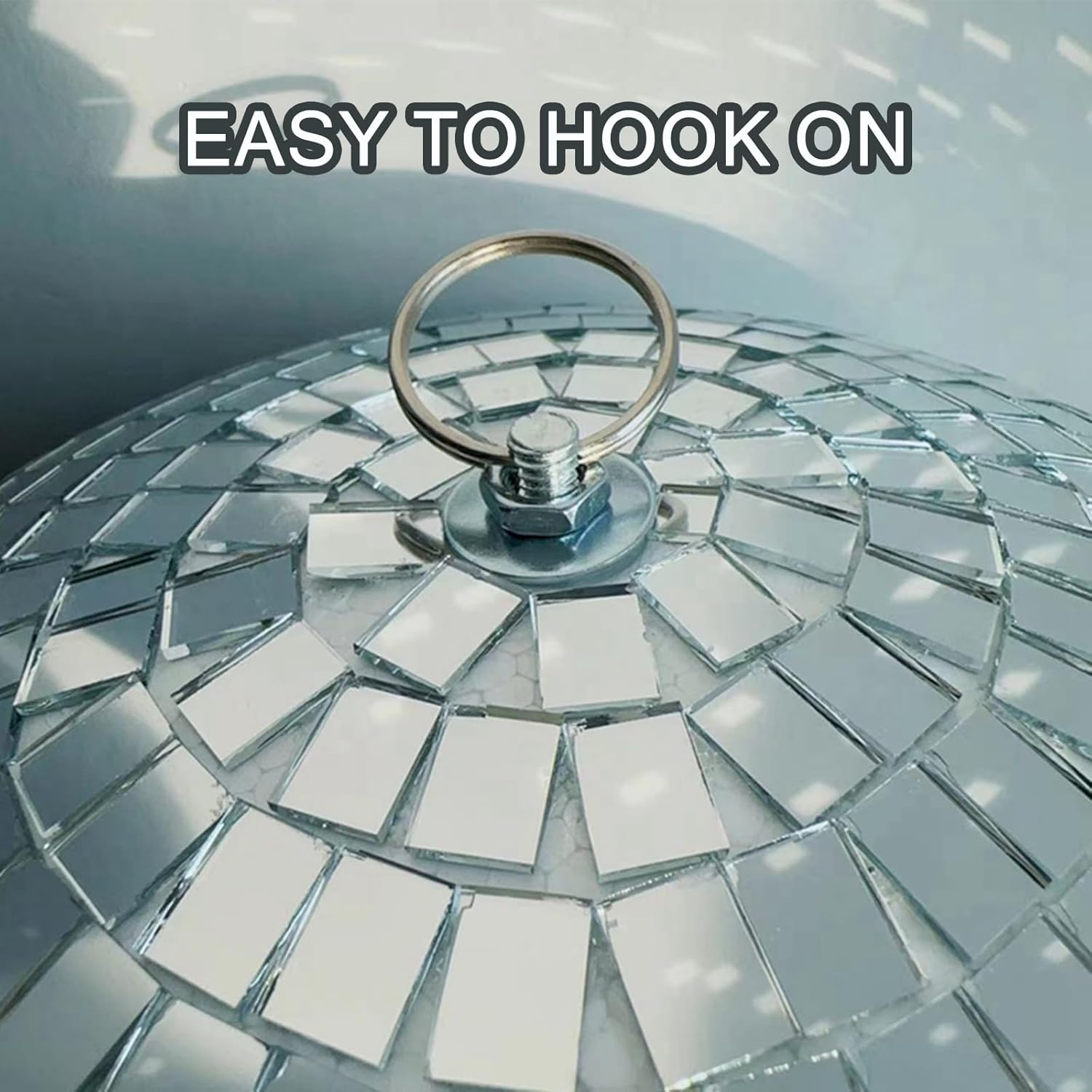
A mirror ball — sometimes called a disco ball — is exactly what it looks like: a sphere covered in hundreds of small, flat mirrors that catch a light beam and spray it across an entire room in spinning, moving dots. That’s the whole trick, and it’s been reliably working since the 1920s. What’s less obvious is that the diameter of the ball (measured in inches), the size of the individual mirror tiles, the speed and torque of the motor that rotates it, and the distance from ceiling to floor all interact in ways that completely change the effect you get. A 4-inch ball from a $12 party pack does something genuinely different from a 20-inch professional unit hanging in a 16-foot ballroom — and buying the wrong size for your space is one of the most common, most fixable mistakes in event lighting. This guide will walk you through every tier, name the tradeoffs, and end with a clear call on which size makes sense for which situation.
Why Size Actually Matters (It’s Not Just About Looking Impressive)
Here’s the physics in plain language: a mirror ball works by reflecting a single, focused light source — ideally a pin spot or a narrow-beam PAR can aimed directly at the ball — outward in every direction. The bigger the ball, the larger each mirror tile can be, and the larger each reflected dot (called a “beam” or “reflection point”) becomes on your walls and ceiling. A 6-inch ball with 5mm tiles throws tiny, sparkly pinpoints. A 20-inch ball with 15mm tiles throws wide, slow-moving slabs of light that wash across a room dramatically.
That means size selection is a room-coverage decision, not just an aesthetics decision. Sound On Sound’s practical guide to DJ and event lighting makes the point clearly: mirror ball diameter should scale with ceiling height and room depth, with the rule of thumb being roughly one inch of ball diameter per foot of room width up to a practical ceiling. Undersizing gets you a pretty centerpiece that doesn’t actually fill the room. Oversizing in a small space creates overlapping reflections that look muddy rather than magical.
The motor matters just as much. A cheap motor rated at 1 RPM (revolution per minute) on a heavy 20-inch ball will stall or wobble. A quality motor from ADJ or Eliminator is rated for the ball weight it’s sold to support, uses a reduction gear rather than a friction drive, and maintains consistent rotation speed under load. ADJ’s product catalog for their mirror ball motor line specifies rated load weights in pounds — a detail that budget listings almost never include, and one that reliably predicts whether your ball will still be spinning at 2 AM.
The Four Tiers: A Buying Map From Party Pack to Pro Install
Tier 1 — Under $30: The 4-Inch to 6-Inch Party Pack
At this end of the market you’re buying a plastic-shell ball with mirrored plastic tiles (not glass), a friction-drive motor with no published RPM spec, and a self-contained LED pin spot that clips onto the hanging bracket. Everything comes in one box. The effect is legitimately fun in a small room — a bedroom, a basement, a bathroom at a house party — because the low ceiling and close walls mean even small reflections fill the space visually.
What you’re trading away: plastic tile edges don’t produce crisp, defined reflection points the way glass does. In a room larger than about 12 feet across, the reflections look dim and scattered rather than theatrical. The motor units in this tier are notorious for making an audible grinding or clicking sound as they run, which is irrelevant at party volume but worth knowing. Several owner reviews aggregated across Amazon listings for this category note motor failure within five to ten uses as a recurring complaint — you’re buying a one-season item, not a keeper.
Our read: For a one-night 70s theme party in a small space, this tier does the job. Don’t plan around it for anything recurring.
Tier 2 — $30–$80: The 8-Inch to 12-Inch Range
This is where the market gets genuinely interesting, and where most party hosts who’ve done a little homework end up. An 8-inch ball with real glass tiles costs $25–$45 for the ball alone; add a compatible ADJ or Eliminator motor ($20–$35) and a single pin spot ($15–$25) and you’re in the $60–$80 range for a complete setup that looks significantly better than any all-in-one kit.
Glass tiles (the spec to look for is “glass mirror” or “mirrored glass” rather than “mirrored acrylic”) produce sharper, brighter reflection points because glass has a higher reflectance and a cleaner edge. The difference is visible to any non-expert eye in a side-by-side comparison — DJ Mag’s 2024 ambient lighting roundup describes the glass vs. plastic distinction as the single most important quality indicator in budget mirror balls.
A 12-inch ball gets you into genuine room-coverage territory for spaces up to about 20 feet across, especially with a ceiling height of 9–10 feet. ADJ sells both the ball and a compatible motor in this range; their motor products in this class publish a rated load and an RPM figure (typically 1–3 RPM adjustable), which is the minimum documentation you should accept when buying a motor separately.
By the numbers:
- 8-inch glass ball + ADJ motor + pin spot: ~$65–$85 complete
- 12-inch glass ball + ADJ motor + pin spot: ~$90–$130 complete
- Effective coverage radius (8-inch): up to 15 ft room width
- Effective coverage radius (12-inch): up to 20 ft room width
Tier 3 — $130–$250: The 16-Inch Working-Event Ball
This is the professional mobile DJ’s everyday tool. A 16-inch glass mirror ball hung at 12–14 feet with a quality pin spot — the Chauvet DJ Rotosphere Q3 is frequently cited in this context — fills a 200-to-500-person room with reflections that reach the far walls. The Chauvet DJ Rotosphere Q3 is worth naming specifically because it bundles a motorized pin-spot system that tracks the ball’s position to maintain an optimal beam angle, a feature that owner reviews on long-run event forums consistently describe as eliminating the setup trial-and-error of matching a static pin spot to a spinning ball.
At this tier, motor quality becomes non-negotiable. Eliminator Lighting’s motor documentation for their 16-inch-compatible units specifies torque output and includes an overload shutoff — if the ball shifts in its cradle and the motor starts to strain, it cuts power rather than burning out. That’s a $5 engineering decision with significant gig-night consequences.
Tile size also scales up here. A 16-inch ball typically uses 10mm to 12mm glass tiles, producing wider, more dramatic reflection sweeps. In a venue with dark walls and low ambient light, the effect moves from “party decoration” to “genuine atmosphere.”
Tradeoff to name explicitly: The 16-inch ball requires a rigging point rated for 8–12 pounds (ball plus motor plus cabling). In venues where you can’t confirm the rigging point rating, a 12-inch ball is the safer professional choice — it’s roughly half the weight with 80% of the visual impact in mid-size rooms.
Tier 4 — $250–$400+: The 20-Inch Eliminator and Permanent Installs
Eliminator Lighting’s 20-inch mirrorball is the landmark product in this category — the unit that gets named whenever the conversation turns to maximum-impact single-ball installs. Published specs from Eliminator Lighting’s 2025 product documentation put the ball weight at approximately 18–22 pounds depending on the model variant, which immediately limits where it can safely hang. This is a permanent or semi-permanent install product: a ballroom, a dedicated venue, a club with engineered rigging. It is not a load-in/load-out item for mobile work.
The visual payoff is proportional. The 20-inch ball uses 15mm glass tiles and produces reflection sweeps wide enough to read by in a mid-size room. At the right ceiling height (14 feet or above), with a professional pin spot aimed correctly, the effect is genuinely unlike anything a smaller ball achieves — the reflections move slowly enough to be individually tracked by the eye, which is the specific quality that gives large mirror balls their hypnotic, enveloping quality.
Price ranges for this tier run $250–$400 for the ball alone; motor and rigging hardware appropriate for the weight add another $80–$150. That’s a $330–$550 commitment for the complete system, plus whatever professional rigging installation costs in your market.
Who actually buys this: Venue operators, high-end event designers on recurring contracts, and serious collectors furnishing period-correct disco listening rooms. Mobile DJs almost universally stop at 16 inches for economic and logistical reasons.
The Pin Spot Question: Don’t Buy the Ball Without Solving This
Every mirror ball needs a light source aimed directly at it. A standard PAR can or wash light pointed in the general direction of the ball produces a muddy, unfocused effect. A pin spot — a narrow-beam fixture, typically a 1-degree to 5-degree beam angle — aimed precisely at the ball’s center produces the sharp, defined reflection points that make the effect work.
For Tiers 1 and 2, the included or bundled LED pin spot is usually adequate. For Tier 3 and above, the Chauvet DJ Rotosphere Q3 is the recurring recommendation in DJ Mag’s lighting coverage and Sound On Sound’s event lighting guides because it automates the alignment problem. Alternatively, a quality fixed LED pin spot (ADJ makes several in the $40–$80 range) with careful manual positioning works well if you’re disciplined about setup.
The math that often surprises first-time buyers: a $200 mirror ball with a $20 pin spot looks worse than an $80 mirror ball with a $60 pin spot. Light source quality is at least as important as ball quality.
The Decision Frame: If X, Then Y
Here’s how to close out your buying decision without overthinking it:
If you’re hosting a one-time party in a room under 15 feet wide: Tier 1 or low-end Tier 2. Spend $40–$70, get the glass-tile version if available, don’t overthink it.
If you’re a mobile DJ doing recurring private events in standard venue rooms (20–40 feet wide, 10–14-foot ceilings): A 12-inch or 16-inch glass ball with a quality motor and a proper pin spot is your working kit. Budget $120–$200 complete. The Chauvet DJ Rotosphere Q3 bundle is the shortcut if you want to skip the alignment learning curve.
If you’re outfitting a permanent venue space or a collector’s room where visual impact is the priority and weight/rigging isn’t a constraint: The Eliminator 20-inch is the honest answer. It’s not mobile-DJ practical, but it’s the best single mirror ball you can buy at any consumer price point, and the effect it produces in the right room justifies the $300–$550 all-in investment.
If you’re buying for a space and aren’t sure of the ceiling height or rigging capacity: Default down one size. A 12-inch ball hung safely beats a 16-inch ball that wobbles or can’t be safely secured. The visual difference is smaller than the liability difference.
Mirror balls are one of the few pieces of event gear where the right answer genuinely scales cleanly with budget and context. Match the ball to the room, solve the pin spot problem, and the physics does the rest.