May 11, 2026 • Roxanne Flair • 9 min reading time • Prices verified June 4, 2026
Standalone DJ Mixers: What the Crossfader Slope Spec Doesn't Tell You
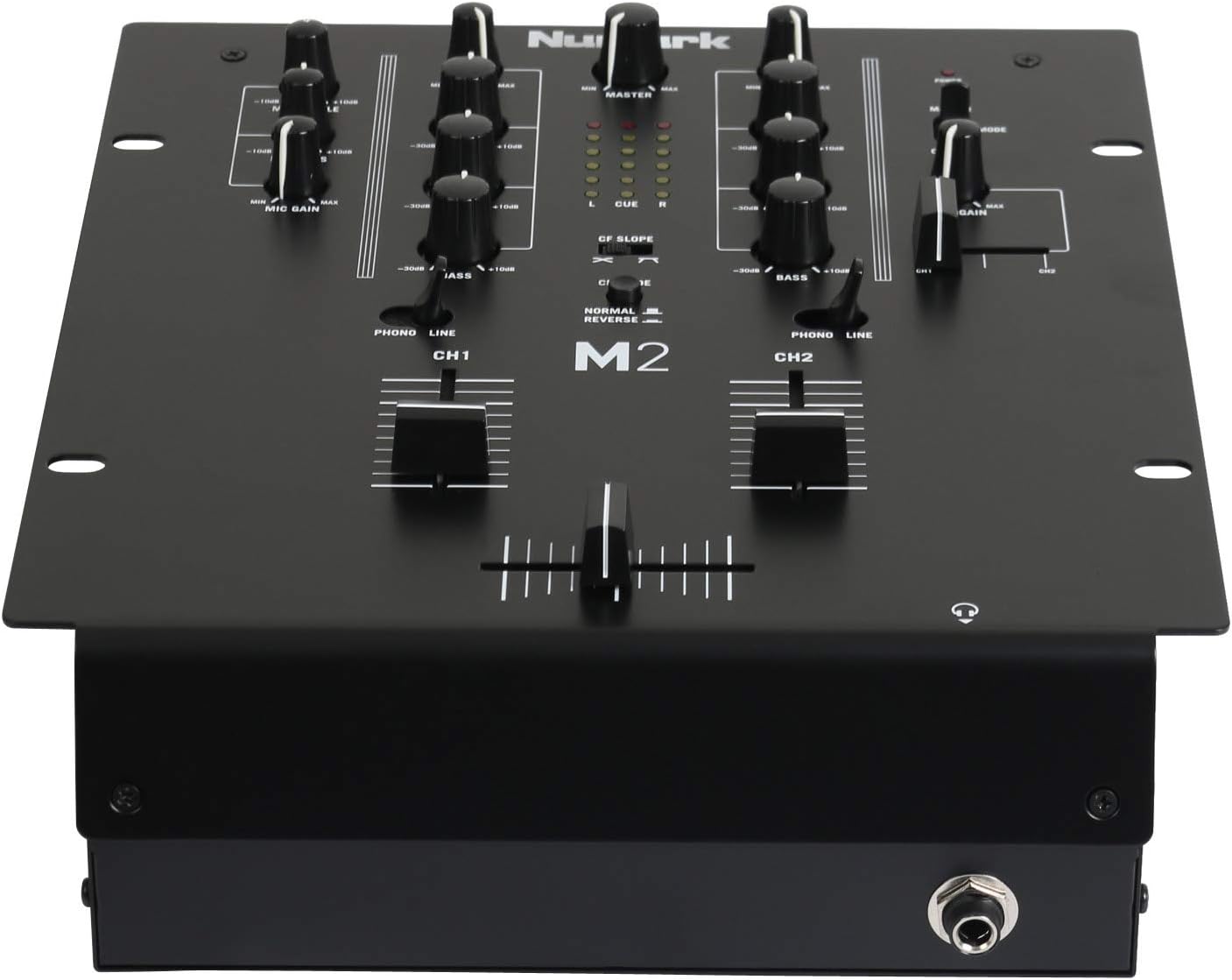
A DJ mixer is the box that sits between your music sources — turntables, media players, a laptop — and the speakers. It lets you blend two tracks together, adjust their volumes and tone, and control how abruptly or smoothly one replaces the other. The crossfader is the horizontal slider at the front of most mixers; its slope (sometimes called “curve”) determines how quickly the audio cuts from one side to the other as you move it. Scratch DJs want a sharp, near-instant cut. Blending DJs want a gentle fade. That single spec — crossfader slope — gets quoted constantly in mixer marketing, and it’s genuinely useful. But if it’s the only thing you’re evaluating, you’re about to miss the things that will actually frustrate you six months into ownership. This guide is for the DJ who already knows what a crossfader is and is trying to figure out which mixer to actually buy — and why the spec sheet is only the beginning of that conversation.
| EDITOR'S PICK[Numark M6 USB - 4-Channel DJ Mi…](https://www.amazon.com/dp/B0041206UW?tag=greenflower20-20) | Mid-tier[Numark M2 - 2-Channel Scratch D…](https://www.amazon.com/dp/B00PB7JD78?tag=greenflower20-20) | Budget pick[Pyle 5-Channel Rechargeable Min…](https://www.amazon.com/dp/B009GU4UHY?tag=greenflower20-20) | |
|---|---|---|---|
| Channels | 4-channel | 2-channel | 5-channel |
| Built-in Audio | ✓ | ✗ | — |
| Crossfader Slope | ✓ | ✓ | — |
| Crossfader Reverse | — | ✓ | — |
| Rechargeable | — | — | ✓ |
| Replaceable X-fader | ✓ | ✓ | — |
| Price | $219.00 | $119.00 | $46.75 |
| See on Amazon → | See on Amazon → | See on Amazon → |
The Three Things the Slope Spec Doesn’t Capture
1. Channel Fader Feel and Wear Rate
The crossfader gets the press, but professional DJs make thousands of channel fader moves per set — those vertical sliders that control the volume of individual inputs. The feel and longevity of those faders matters at least as much as the crossfader curve for most working DJs.
Mixer manufacturers use several fader mechanisms. The two dominant technologies are conductive plastic (used in most budget and mid-tier mixers, smooth but subject to gradual wear) and optical faders (used in high-end units like the Rane Seventy-Two MKII and the Allen & Heath Xone:96, where infrared light reads fader position instead of a physical contact strip, so there’s nothing to wear out). Sound On Sound’s review of the Rane Seventy-Two MKII specifically flags the optical crossfader as a durability advantage for scratch-heavy use — no contact, no degradation over time.
The practical implication: if you’re doing 100+ gigs a year in sweaty clubs or outdoor festivals, the $1,400 price difference between a Pioneer DJM-750MK2 and a DJM-900NXS2 buys you, in part, component-quality insurance. If you’re doing 20 polished mobile events a year where the mixer never leaves a foam-lined case, that gap narrows considerably.
2. Routing Architecture and Send/Return
Routing means how many ways you can get audio in and out of the mixer, and whether you can insert external effects processors into the signal chain. Most entry mixers offer two to four stereo channels and a basic booth output. Pro mixers add things like:
- Send/return loops — a dedicated output path that lets you run audio through an external reverb, compressor, or hardware effect and bring it back into the mix without degrading the main signal
- USB audio interface integration — internal audio interfaces that let you record directly to a laptop or run stems into software without a separate interface box
- Multiple mic channels with EQ — critical for mobile DJs handling MC duties or karaoke sets
DJ Mag’s 2025 mixer roundup makes the point clearly: the Allen & Heath Xone:96 justifies its ~$2,200 street price in large part because of its four independent send/return loops — a feature that has essentially no equivalent at lower price points and makes it the mixer of choice for live-hybrid sets where hardware synthesizers and drum machines are part of the performance. For a straight DJ who plays from two CDJs and never touches external gear, that routing depth is wasted money. For the DJ building a hybrid live setup, it’s the entire reason to buy the unit.
3. Internal Sound Quality: The Bit Depth and Preamp Reality
Every digital mixer processes your audio internally. The bit depth (24-bit is standard; some units process at 32-bit internally) and the quality of the analog-to-digital converters (the chips that translate the electrical signal from your turntables into digital data) both affect sound quality — but not always in ways a spec sheet makes obvious.
The number that matters more than bit depth for most working DJs is signal-to-noise ratio, measured in dBu, which tells you how much unwanted hiss and noise the mixer adds to your signal. Budget mixers often spec 80–85 dB SNR. Pro units like the DJM-900NXS2 and Rane Seventy-Two MKII are rated at or above 95 dB. Resident Advisor’s coverage of the DJM-900NXS2 notes that club engineers consistently praise its clean, transparent signal path — the mixer “gets out of the way of the music” in a way that cheaper units don’t. For a basement house party through a Bluetooth speaker, you’ll never notice. For a club system with $40,000 in amplification, you absolutely will.
A Four-Tier Framework for Choosing
This is where the “if X, then Y” logic starts to crystallize. Here are the four realistic price tiers as of mid-2026, with honest assessments of what each actually delivers:
By the numbers — standalone DJ mixer market (May 2026):
| Tier | Street Price Range | Representative Units |
|---|---|---|
| Entry | $150–$350 | Pioneer DJ DJM-250MK2, Numark M6 USB |
| Mid | $500–$900 | Pioneer DJ DJM-750MK2, Denon DJ X1850 |
| Pro | $1,100–$1,600 | Pioneer DJ DJM-900NXS2, Rane Seventy-Two MKII |
| Specialist | $1,800–$2,500 | Allen & Heath Xone:96, Allen & Heath DB4FX |
Entry ($150–$350): The Pioneer DJM-250MK2 is the standard recommendation here. Two channels, solid build for the price, USB audio interface built in. Owners consistently report it holds up fine for home practice and occasional small gigs. The crossfader is replaceable if it degrades. What you’re giving up: zero send/return, limited EQ control, a signal path that will sound congested on a large system. If you’re learning fundamentals or hosting themed parties rather than running professional bookings, this is exactly the right amount of mixer to buy.
Mid ($500–$900): The Denon DJ X1850 is an underrated value play at this tier, particularly if you’re in a Pioneer-heavy club environment and want something that won’t be mistaken for the house gear. Four channels, a clean 24-bit signal path, and built-in effects that Mixmag’s gear guides describe as genuinely usable rather than gimmicky. The DJM-750MK2 is the safe, familiar choice — spare parts are everywhere, and its layout is identical to the DJM-900NXS2, so any club you play that has a house mixer will feel like home. The tradeoff is that the 750 doesn’t give you much that the 900 doesn’t do better; if you’re within 8–10 gigs of being able to justify the 900, save up and skip this tier.
Pro ($1,100–$1,600): This is the most important decision tier for working mobile DJs, and the choice is genuinely contextual. The DJM-900NXS2 is the industry standard — if you play club dates, the house mixer will almost certainly be a 900NXS2, so owning one means you already know every knob and button before you show up. That familiarity has real economic value. The Rane Seventy-Two MKII is the scratch and battle DJ pick — Serato integration is deeper and more stable than anything Pioneer offers, and the optical faders are purpose-built for the mechanical demands of scratch technique. Sound On Sound’s review of the Rane confirms that Serato timecode response on the Seventy-Two is measurably tighter than on Pioneer equivalents. These are not the same mixer aimed at the same DJ.
Specialist ($1,800–$2,500): The Allen & Heath Xone:96 is the choice for the DJ who also makes music. The four send/return loops, the famously warm analog filter section, and the exceptional phono preamp (critical if you’re playing vinyl) justify the premium for a specific kind of buyer. If your sets are purely digital and club-oriented, this mixer is expensive in ways that don’t pay back. If you’re running Eurorack gear, hardware synths, or playing records on a Technics SL-1200 into a high-end system, the Xone:96 is the right tool and the price is honest.
The Variables Most Buyers Don’t Price In
Replacement crossfaders: Conductive crossfaders on pro mixers typically run $30–$80 for OEM replacements. Budget that into your real cost of ownership if you scratch heavily. Optical faders don’t need replacing — that’s a real advantage that doesn’t show up in sticker price comparisons.
Club rider reality: If you’re building toward a club residency or touring bookings, your rider (the list of gear you request from venues) becomes relevant. DJM-900NXS2 is on the rider of 95% of professional club DJs precisely because it’s everywhere. Showing up with deep knowledge of a mixer that the venue doesn’t stock means you’re always playing on unfamiliar gear unless you bring your own. That’s a real operational cost.
Phono preamp quality for vinyl users: Most mixers include built-in phono preamps (the amplification stage required for turntable signals, which are much quieter than line-level inputs). Budget mixer preamps are frequently the weakest component in the signal chain. If you’re playing original Salsoul or West End pressings and care about fidelity, the Xone:96’s phono stage is consistently praised in audiophile DJ forums; the DJM-900NXS2’s is adequate but not exceptional. This matters enormously to some buyers and not at all to others.
Software lock-in: Serato and rekordbox, the two dominant DJ software platforms, have hardware integration that goes beyond basic connectivity. Certain features — Serato Flip for cue point manipulation, rekordbox’s cloud library sync — only work with specific certified hardware. Before you buy, map your software workflow against the certified hardware list. Mixmag’s gear guides have consistently flagged software-hardware compatibility as one of the most common sources of post-purchase frustration at the intermediate level.
The Decision Rule
If you’re a working mobile DJ doing paid events and your goal is professional-grade results on a real budget: buy the DJM-900NXS2 and don’t look back. The club familiarity, the signal quality, the ecosystem, and the resale value all point the same direction. The Rane Seventy-Two MKII is a better choice if and only if scratch technique or deep Serato integration is central to your performance style. If you play vinyl on a real system and have hybrid live ambitions, save an extra six months and buy the Xone:96 — it’s the only mixer in this guide that fully serves that use case. And if you’re still building toward your first dozen bookings, the DJM-250MK2 is entirely sufficient — don’t let anyone sell you a pro mixer before your gig calendar justifies it.
The crossfader slope spec will get you to the right category of mixer. Everything in this guide is what gets you to the right mixer.