May 26, 2026 • Roxanne Flair • 9 min reading time • Prices verified June 4, 2026
Disco Ball Motors: What RPM Actually Does to Your Dance Floor
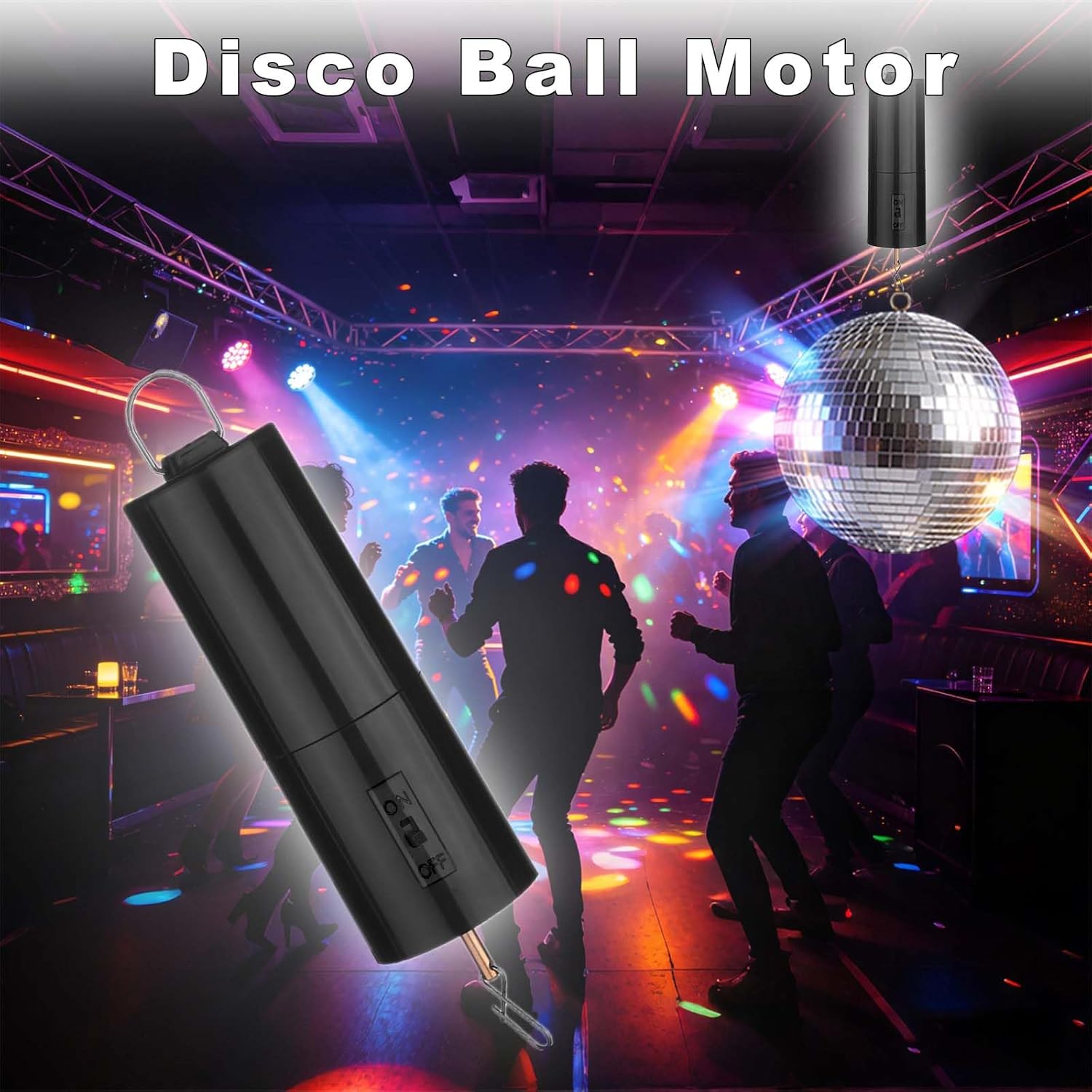
A mirror ball is exactly what it sounds like: a foam or cardboard sphere covered in hundreds of small mirrored tiles that bounce light around a room. You hang it from the ceiling, point a spotlight at it, and it turns — scattering hundreds of tiny bright reflections across every wall, the floor, and everyone dancing. The motor is the small electric device that makes it spin. And the thing most first-time buyers overlook is that the speed of that spin — measured in RPM, or rotations per minute — matters more to the final effect than almost any other variable. Buy a motor that’s too fast for your room and you get a strobing, disorienting mess. Too slow and the effect feels lethargic, like a chandelier rather than a dance floor. This guide explains exactly how to match motor speed to your situation, with named product picks across three price tiers and a decision rule at the end.
Why RPM Is the Variable Nobody Talks About
Here’s the honest framing: most lighting guides spend their word count on ball size (8-inch, 12-inch, 20-inch) and tile density, and then toss in motor speed almost as an afterthought. That’s backwards for a practitioner. The size of the ball controls the number and size of reflected beams. The motor speed controls how fast those beams sweep across the room. Both matter, but RPM is the variable you can control cheaply — and the one that completely changes the room’s mood.
The physics are straightforward. A mirror ball spinning at 1 RPM completes one full rotation in 60 seconds. At 5 RPM, it completes five rotations per minute. Each mirrored tile sweeps through its arc proportionally faster. In a 15-foot-wide room, a reflected beam from a 1 RPM motor might travel across one wall over roughly 10–12 seconds — slow, dreamy, classic 1970s ballroom energy. That same beam at 5 RPM crosses the wall in about 2 seconds. At 10 RPM, you’re approaching strobe-adjacent territory that reads less “Saturday Night Fever” and more “budget nightclub.”
Sound On Sound’s “Stage Lighting Fundamentals for the Working DJ” (2024) makes the point directly: slower RPM settings are almost universally more flattering for social dancing because the moving light doesn’t distract from conversation and movement the way rapid sweeping does. The faster settings have their place — DJ Mag’s “Best Mirror Balls and Accessories” (2025) notes that some club DJs deliberately run motors at 4–6 RPM during peak build moments and then drop them back to 1–2 RPM during a melodic breakdown — but slower is the default for a reason.
The RPM Ranges, Decoded
0.5–1 RPM — Lounge and Slow-Dance Mode
This is the range you want for a seated dinner that becomes a dance floor, a wedding reception, or a 1970s-themed event where accuracy to the era matters. Reflections move slowly enough that guests register them as ambient atmosphere rather than active lighting. The effect is warm, continuous, and unobtrusive. A 12-inch or larger mirror ball at this speed in a standard 20-by-20-foot room fills all four walls with lazy drifting light spots. It does not demand attention — it rewards it.
The tradeoff is that very small rooms (under 12 feet across) can feel underwhelming at sub-1 RPM because there simply isn’t enough wall surface for the slow sweep to feel expansive.
1–3 RPM — General-Purpose Dance Floor
This is the workhorse range and the one ADJ Products’ mirror ball motor spec sheets consistently position as the primary use case for their single-speed motors. A 2 RPM motor on a 12-inch ball in a 25-foot gymnasium is the textbook disco setup. Fast enough to be kinetic, slow enough to feel classic. DJ Mag’s 2025 mirror ball guide calls 1–3 RPM “the safe zone for anything from a backyard birthday to a mid-size club warm-up room.” If you’re buying a single motor for a mobile rig and you can only pick one speed, pick something in this range.
4–6 RPM — High-Energy and Accent Use
At this speed, the ball starts to feel more like an effect light than an atmosphere light. Reflections sweep fast enough to compete with other lighting in the rig. Useful during peak energy moments, but tiring as a constant. Mixmag’s “Club Lighting on a Budget” (2024) notes that the best-received rooms tend to pair a slow-running mirror ball with faster accent fixtures rather than running the ball itself at high RPM — the ball provides the romance, the other lights provide the punch.
7 RPM and Above — Special Effects Only
Most permanent installations never touch this range. At 7–10 RPM the mirror ball starts to feel less like an aesthetic choice and more like a malfunction. Some theatrical and rave-adjacent setups use it deliberately for disorientation effects, but for disco, retro-dance, or general event work, this range is almost never the right answer.
Motor Tiers: What You Get at Each Price Point
Tier 1 — $12–$40: Single-Speed Budget Motors
The typical import motor in this range runs at a fixed 1–2 RPM and is rated for balls up to 12 inches (roughly 5–6 lbs). ADJ Products’ spec sheets for their entry mirror ball motor line publish a maximum load of 5 lbs at rated RPM, which is worth checking against your ball’s actual weight before mounting.
Owners on long-run review threads consistently report that these motors are adequate for one-off party use but that the gear train wears noticeably after 30–50 hours of runtime — not a problem if you’re running three events a year, a real concern if you’re running three events a week. For a first-time party host buying a 70s theme kit in the $30–$80 range, a single-speed motor at this tier is the right call. Don’t over-invest here.
Tier 2 — $45–$120: Variable-Speed Motors with Dial Control
This is where the decision math shifts for mobile DJs. Variable-speed motors in this range — ADJ’s MBM (mirror ball motor) lineup and comparable units from Eliminator Lighting cover most of this bracket — let you dial RPM via a thumbwheel or stepped selector, typically covering 0.5 RPM to 4 or 5 RPM. That range flexibility is genuinely useful when you’re reading a room.
More important for working DJs: the motors at this tier are generally rated for 12-inch and 16-inch balls (up to 12–15 lbs depending on model), have metal gear components rather than plastic, and are built for sustained runtime. Across aggregated reviews, the pattern is clear — owners running these motors at 50-plus hours per month report minimal wear over 12–18 months of regular use, which is the baseline you need for paid event work.
At roughly $65–$90 street price (as of mid-2026), the ADJ variable-speed motor units represent the point where the cost-per-gig math works cleanly for a mobile DJ doing 2–4 events per month.
Tier 3 — $150–$350+: DMX-Controlled and High-Capacity Motors
DMX is the standard communication protocol that lets a lighting controller send commands to multiple fixtures simultaneously — think of it as a universal remote for your whole light rig. A DMX-controlled mirror ball motor lets you trigger speed changes, direction reversals, and timed pulses from the same console you’re already using to manage your wash lights and strobes.
Chauvet DJ’s lighting buyer’s guide (2025 edition) highlights DMX motor control as particularly effective for theatrical sequences — building from 0.5 RPM during a slow intro up to 3 RPM at drop, then reversing direction for a visual accent. For a DJ with a full DMX rig already running, this is a logical add-on. For someone running a standalone mirror ball at a wedding, it’s a solution to a problem you don’t have.
High-capacity motors at this tier are also the correct answer when you’re hanging a 20-inch or larger ball — these can weigh 20–35 lbs, and the load ratings on budget motors simply don’t cover that range safely.
By the numbers — RPM quick-reference:
| RPM Range | Best For | Room Size Sweet Spot |
|---|---|---|
| 0.5–1 RPM | Dinner, slow-dance, lounge | Any size |
| 1–3 RPM | General dance floor | 15–40 ft across |
| 4–6 RPM | Peak-energy accent moments | 25 ft+ |
| 7 RPM+ | Theatrical / special FX | Specific use only |
The Hang Height Variable Most Buyers Ignore
Motor RPM and room effect don’t exist in isolation — hang height changes the math significantly. A mirror ball hung at 8 feet in a living room at 2 RPM will feel substantially faster than the same ball at 14 feet in a ballroom at the same RPM, because the reflected beams have less distance to travel before hitting a wall. Sound On Sound’s lighting fundamentals piece flags hang height as one of the most common variables DJs miscalibrate when setting up in unfamiliar venues.
The practical rule: lower ceilings compress the visual effect and make a given RPM feel faster. If you’re regularly working rooms under 10-foot ceilings, aim for the lower end of your target RPM range. If you’re working 16-foot-plus ceilings in event spaces, you can push toward the higher end without the effect feeling chaotic.
The Decision Frame
If you’re assembling a one-night party kit on a $30–$80 budget, buy a fixed-speed motor at 1–2 RPM in the $12–$25 range and spend the savings on a better ball or a second light. The variable-speed capability is genuinely wasted on a single event.
If you’re a working mobile DJ running 20 or more events per year, the $65–$90 variable-speed motor is the right investment — not because you’ll use every setting at every event, but because reading the room and matching speed to the moment is part of what separates a professional atmosphere from a good one. The gear should support that instinct, not constrain it.
If you’re already running a full DMX rig and want the mirror ball integrated into programmed sequences, the $150–$250 DMX motor tier pays for itself in the production value of a single well-executed drop. If you’re not running DMX, it doesn’t.
The honest summary: for most practitioners in year one or two, the variable-speed motor at Tier 2 is the pick. It gives you the range to be intentional, the build quality to be reliable, and the price point to be rational. Start there, and upgrade toward DMX control only when your console is already calling for it.