May 9, 2026 • Roxanne Flair • 9 min reading time • Prices verified June 4, 2026
Your First DJ Controller: How the Entry-Level Chasm Actually Works in 2025
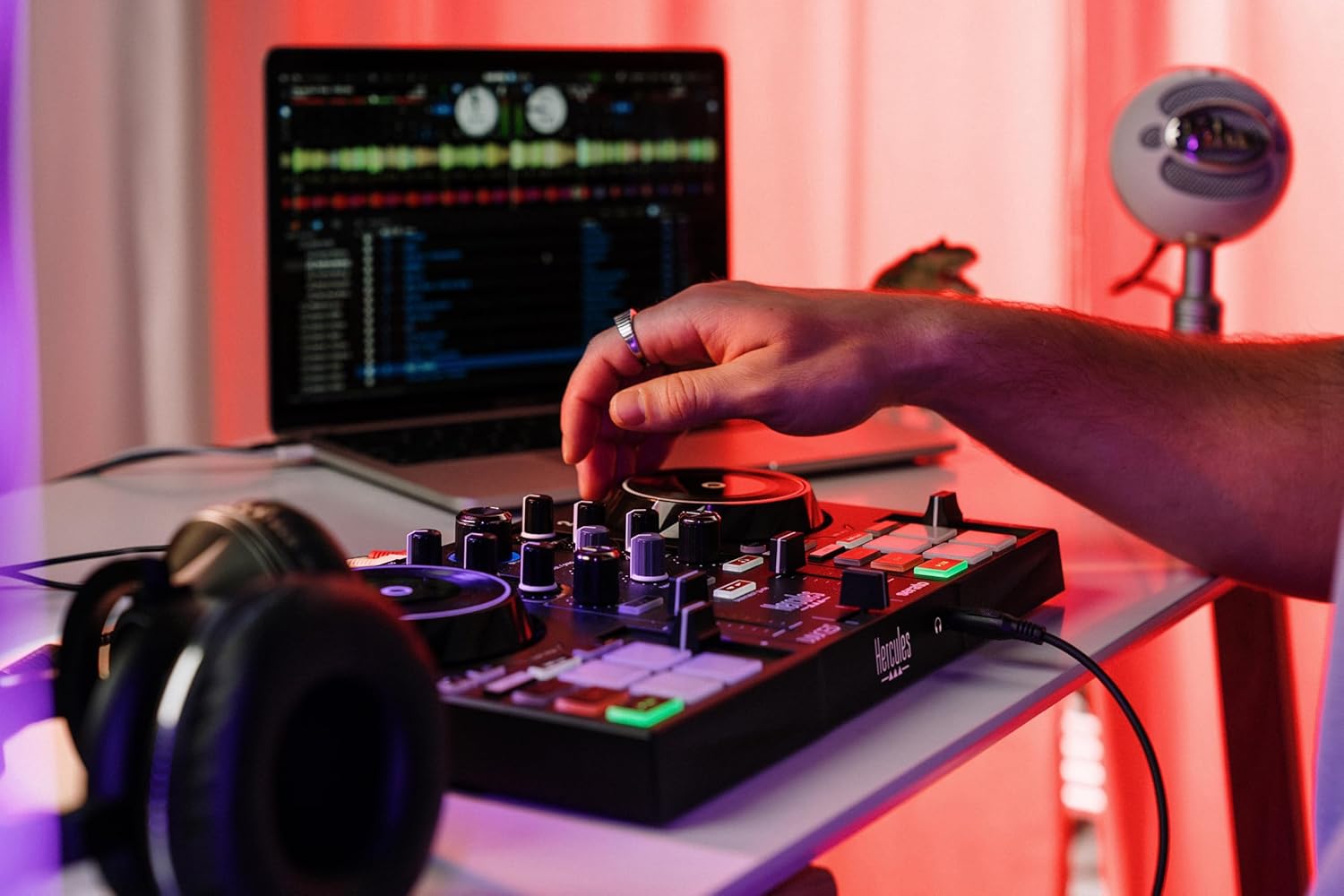
A DJ controller is the hardware box a DJ uses to mix music — it combines two virtual “decks” (think of them as digital record players), a mixer section in the middle, and a bunch of knobs and buttons that control DJ software on a laptop. You plug it in via USB, open software like Serato DJ or rekordbox, and suddenly your laptop becomes a professional mixing setup. If you’ve been curious about DJing — whether for home parties, a future paid gig, or just the satisfaction of learning the craft — a controller is almost always the right first purchase. The problem is the market at the low end is a minefield. There’s a meaningful cliff between gear that will actually teach you to DJ and gear that will frustrate you into quitting, and that cliff is invisible from the product page. This guide is about finding where that cliff is, how to read the specs that matter, and which specific controllers are worth your money at each price point in 2026.
The Real Entry-Level Chasm: $99 vs. $299 vs. $449
Here’s the uncomfortable truth that most “beginner DJ controller” roundups skip: there are effectively three product categories that get sold under the same marketing language, and two of them aren’t really viable for learning.
The toy tier ($79–$149) includes controllers like the Hercules DJControl Inpulse 200 MK2 and the Numark Party Mix II. These aren’t useless — DJMag’s buying guide acknowledges the Inpulse series as an on-ramp for absolute beginners with zero budget — but they share a critical hardware compromise: tiny, lightweight jog wheels (the circular platters you use to cue and scratch records). Jog wheels in this tier are typically 6 inches in diameter with minimal resistance and no motorized feel. More critically, they lack the high-resolution sensors that let you make tight, precise cue points. Owners across aggregated forum reviews consistently describe the same experience: the controller works for the first few weeks, then the limitations of the jog wheel become the ceiling on your progress.
The viable beginner tier ($249–$349) is where learning actually starts. The Pioneer DJ DDJ-FLX4 ($299 street) and the Denon DJ SC Live 2 competitors in this range represent a step change in build quality and jog wheel performance. Sound On Sound’s review of the DDJ-FLX4 specifically calls out the jog wheels as “full-size at 6-inches with adjustable tension” — a hardware feature that makes beat-juggling and precise cueing meaningfully easier to learn. This tier also typically unlocks full versions of major DJ software rather than “lite” bundles with track limits.
The serious beginner / early professional tier ($399–$549) includes the Pioneer DJ DDJ-FLX6-GT and the Numark Mixtrack Pro FX at its lower end, and represents a controller you can take to a small paid gig without embarrassment. The DDJ-FLX6-GT adds a four-channel layout (meaning you can mix four tracks simultaneously, not just two), a feature that becomes important once you start playing actual events.
By the numbers
Price Range Jog Wheel Diameter Software Bundle Channels $79–$149 ~5–6 in., low tension Lite / restricted 2 $249–$349 6 in., adjustable Full Serato / rekordbox 2 $399–$549 6–8 in., adjustable Full + advanced features 2–4
The Spec Traps Nobody Warns You About
If you’re six months into your DJ education and currently staring at a product page trying to decide, these are the specs that are frequently misread.
“Full-size jog wheels” is not a standard measurement. Manufacturers use this phrase loosely. A 6-inch jog wheel on a $299 controller and a 6-inch jog wheel on a $150 controller can feel completely different because of the sensor resolution underneath. MixMag’s 2025 controller roundup notes that jog wheel “feel” depends on both diameter and the encoder resolution beneath the platter — and that the spec sheet rarely tells you which you’re getting. The proxy to use: read owner reviews specifically for the phrase “jog wheel lag” or “jog wheel deadzone.” Those complaints cluster heavily in the sub-$200 tier and nearly disappear above $300.
“Works with Serato / rekordbox” doesn’t mean it’s fully mappable. Some controllers ship with “HID mode” support, meaning the hardware talks directly to the software at a deep level — transport controls, effects, hot cues all map natively. Others rely on MIDI mapping, which works but requires manual setup and doesn’t always support every feature. Per Resident Advisor’s gear primer, HID support is a meaningful practical advantage for beginners because it eliminates the configuration step that causes a lot of early frustration. The DDJ-FLX4 and DDJ-FLX6-GT both ship with native HID support for rekordbox and Serato DJ Pro.
“Built-in sound card” quality varies enormously. Every controller has an audio interface built in — it converts digital audio to the analog signal your speakers need. At the toy tier, these interfaces are typically 16-bit/44.1kHz, which is technically CD quality but with marginal headroom before distortion. At the $299+ tier, you’re typically getting 24-bit output, which matters mostly for your monitoring headphone output clarity — the ability to hear the next track clearly in your headphones while the current track plays through speakers is fundamental to DJing, and a low-quality interface makes that harder.
Software “lite” bundles have invisible track limits. This one bites a lot of first-time buyers. Controllers in the sub-$200 range typically bundle Serato DJ Lite, which as of 2025 limits your library to a fixed number of tracks per crate and excludes certain effects and features. It’s enough to learn on, but if you have a real music library, you’ll hit the ceiling faster than expected. The jump to Serato DJ Pro costs roughly $9.99/month on subscription — a cost that’s worth factoring into your actual total.
The Decision Frame: Which Tier Is Actually Right for You
This is where most guides fail you by being non-committal. Here’s a direct decision tree based on your honest situation.
If your total budget including speakers, headphones, and software is under $300: Buy the Pioneer DJ DDJ-FLX4 at ~$299 and skip dedicated speakers for now — practice with headphones. The DDJ-FLX4 bundles rekordbox DJ (full version) and has genuine resale value if you outgrow it. Do not buy a $150 controller plus $150 speakers. The controller quality matters more than monitoring quality at this stage.
If you’re planning to play a real event in the next 6–12 months — a house party, a friend’s wedding, a local bar gig — start at the DDJ-FLX6-GT ($449 street) rather than the FLX4. The four-channel layout gives you the ability to mix in intro music under your main track, layer a third record for effects, or cover a hardware failure with a backup track. DJMag’s 2025 controller roundup explicitly flags the FLX6-GT as the first Pioneer controller in the beginner line to be “gig-viable out of the box.” The $150 price difference buys you operational headroom at live events that is worth every dollar.
If you already have a controller and are deciding whether to upgrade: The honest advice is that most people upgrade their controllers before they’ve fully learned the one they have. The jog wheel sensitivity on a $299 controller is not what’s holding back a six-month-in DJ. Your ears, your track selection, and your mixing intuition are. Don’t upgrade hardware until you’ve hit a specific, nameable technical limitation — not just a general feeling that better gear would help.
On used market sourcing: The DDJ-FLX4 and DDJ-400 (its predecessor, still excellent) both appear regularly on Reverb and Craigslist in the $150–$220 range. Unlike vintage turntables or mixers, these controllers have no meaningful wear points if the previous owner treated them normally — the jog wheel encoders and faders are the only real failure surfaces, and you can test both in under two minutes. Buying a DDJ-400 used at $180 is a better DJ education investment than buying a new $149 toy-tier controller.
The Software Question You’re Probably Underestimating
Controllers are essentially USB keyboards for DJ software — the real brain of your setup is Serato DJ Pro, rekordbox, or Traktor Pro 3 (Native Instruments’ platform). This matters for your buying decision because different controllers unlock different software, and switching platforms later means re-learning your workflow.
Pioneer DJ controllers activate rekordbox DJ natively. If you eventually want to play at clubs — virtually every professional club in 2026 runs Pioneer CDJ media players and a DJM mixer — learning in rekordbox means your cue points, loops, and track organization transfer directly to the club setup. Resident Advisor’s gear primer describes this as one of the most underrated practical advantages of Pioneer DJ’s controller ecosystem for aspiring club DJs.
Numark and Rane controllers typically bundle Serato DJ Pro. Serato has a larger installed base among mobile and wedding DJs and arguably has better playlist management for event work. If your goal is mobile DJ gigs rather than club residencies, Serato’s workflow is widely regarded by working DJs in forum communities as marginally faster for live event setups.
Neither platform is wrong. But pick one and commit — the switching cost in re-learning workflow is real.
The Verdict
For the reader with no current controller: Buy the Pioneer DJ DDJ-FLX4 if your budget is $300 or under, and the DDJ-FLX6-GT if you have $450 and a real gig on the horizon. Avoid everything under $200 unless your total all-in budget simply won’t stretch further. The jog wheel and software quality gap at the $200 threshold is the entry-level chasm the article title refers to — and it is genuinely a chasm, not a slope.
For the reader with a toy-tier controller already: You’ve probably already felt the ceiling. The upgrade to a DDJ-FLX4 (new or used) will feel like a different instrument. Time that purchase to when you can feel the specific limitation in your hands — it’ll mean more once you know exactly what problem you’re solving.
For the reader deciding between new and used: Used DDJ-400 or DDJ-FLX4 on Reverb at $160–$220 is the best value in the entire beginner DJ market in 2026, full stop. Test the jog wheels and faders, confirm the USB handshake works with your laptop before you hand over cash, and you’re in.
The gear is not what makes you a DJ. But the wrong gear at the wrong tier can absolutely stop you from becoming one.